Types of Supercomputers: A Complete Guide to High-Performance Computing
Published: 26 Sep 2025
Did you know that not every supercomputer is the same? Many people believe a supercomputer is simply a large, fast machine. In reality, there are multiple types of supercomputers, each designed for a specific purpose. Some specialize in calculations, while others work with large datasets. So, how are they different? Let us find out.
What is a Supercomputer?
A supercomputer is a high-performance computer that can handle large amounts of data and perform difficult calculations at amazing speeds. It is far stronger than traditional computers and is utilized for activities such as weather forecasting, scientific simulations, and artificial intelligence. Supercomputers use thousands or even millions of processors to solve problems that would take traditional computers years to finish.
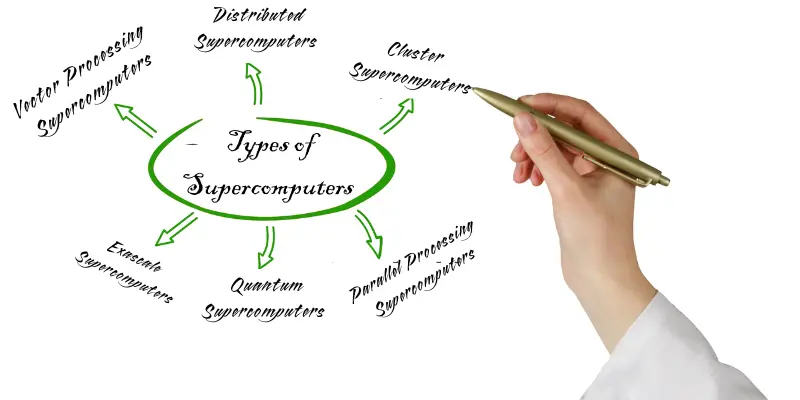
Types of Supercomputers
Supercomputers have different types, and each type is used for different purposes. Here are some common types of supercomputers you should know:
1. Vector Processing Supercomputers
- Designed to handle massive mathematical operations effectively.
- Vector processors can process numerous data points independently.
- Suitable for weather modeling, scientific simulations, and engineering computations.
- Frequently used in physics, aerospace, and cryptography.
- Provides high-speed performance but requires specialist software.
- It can be costly when compared to other types of supercomputers.
2. Parallel Processing Supercomputers
- Divides tasks among numerous processors to perform multiple calculations at the same time.
- They are faster and more efficient than traditional computers, making them suitable for artificial intelligence, research, and simulation.
- Breaks down large problems into smaller jobs, which are then processed simultaneously.
- Uses two major memory models:
- Shared memory allows all CPUs to access the same memory.
- Distributed Memory: Every processor has its own memory unit.
- Common applications include weather forecasting, scientific research, deep learning, and financial modeling.
- To get optimal performance, specialist programming languages such as MPI (Message Passing Interface) and OpenMP are required. These are examples of software designed to boost supercomputer performance.
- High power consumption and heat generation necessitate the use of modern cooling systems.
- Examples: IBM Summit, Fugaku, and Tianhe-2 are the top parallel processing supercomputers
3. Distributed Supercomputers
- Uses multiple interconnected computers to work as one system.
- Distributes processing tasks across several machines instead of relying on a central processor.
- Connected through high-speed networks using reliable network cables for fast data exchange.
- Highly scalable, allowing more computers to be added for increased computing power.
- Commonly used in: Cloud computing, big data analytics, weather simulations, and scientific research.
- Cost-effective compared to traditional supercomputers, as it utilizes standard hardware.
- Requires specialized software to efficiently manage workload distribution.
- Relies on network stability, as communication delays can impact performance.
4. Cluster Supercomputers
- Consists of several networked computers (nodes) that function as a single system.
- Connected via high-speed networks to ensure quick information transfers.
- They use off-the-shelf hardware, which is less expensive than typical supercomputers.
- Highly adaptable, allowing additional nodes to be added for improved performance.
- Common applications include scientific research, weather forecasting, artificial intelligence, and financial modeling.
- To ensure effective operation, cluster management software such as MPI, OpenMP, or Hadoop is required.
- Provide higher processing power at a lower cost than centralized supercomputers.
- Depending on network reliability, delayed communication between nodes might degrade performance.
5. Quantum Supercomputers
- Use quantum mechanics to do extremely rapid calculations.
- Process information with qubits, which can be in numerous states at the same time (superposition).
- Capable of solving complicated problems significantly faster than traditional supercomputers.
- Ideal for use in cryptography, artificial intelligence, drug development, climate modeling, and material science.
- Although still in its early stages, these technologies have the potential to transform computing.
- Extremely low temperatures (near absolute zero) are required, as are regulated settings.
- They are highly sensitive to interference, making scaling problematic.
- IBM, Google, and D-Wave are the leading corporations working on quantum supercomputers.
6. Exascale Supercomputers
- Exaflops are capable of processing a quintillion (10¹⁸) calculations per second.
- The fastest and most powerful supercomputers in existence.
- Designed to handle large-scale simulations and complicated data processing.
- Applications include environmental modeling, nuclear research, artificial intelligence, healthcare, and astrophysics.
- A significant improvement in mathematical performance, resulting in higher accuracy and faster problem-solving.
- Extremely high power usage and specialized cooling systems are required.
- Set the stage for advancements in medical, energy research, and materials science.
- The top exascale supercomputers are Frontier (Oak Ridge National Laboratory), Aurora (Argonne National Laboratory), and El Capitan (Lawrence Livermore
How to Choose the Right Type of Supercomputer
Choosing the right type of supercomputer depends on your requirements, budget, and the types of tasks you need to complete. Here’s what you should consider:
1. Define Your Purpose
- Need to perform a calculation quickly? Go for vector processing supercomputers.
- Running large-scale simulations or AI models? Parallel processing supercomputers are the best.
- Need a solution that is both affordable and scalable? Select a distributed supercomputer.
2. Consider Processing Power
- More complex tasks need higher processing power and multiple processors.
- If your work involves heavy computations, go for a parallel processing system.
3. Scalability and Cost
- Distributed supercomputers are more cost-effective since they connect different systems.
- Large enterprises may require custom-built supercomputers, which are costly.
4. Energy and Cooling Needs
- Supercomputers require huge amounts of power and strong power supplies along with cooling systems.
- Ensure you have the right infrastructure before investing.
5. Future-Proofing
- Choose a system that allows upgrades and expansion.
- Look for modern architectures like quantum computing if long-term usage is needed.
Common Mistakes to Avoid When Buying a Supercomputer
Purchasing a supercomputer is a huge investment, and selecting the wrong option might result in wasted resources. Here are some common mistakes you should avoid:
1. Ignoring Your Specific Needs
- Not all supercomputers are the same. Choosing the wrong one can result in inefficiency.
- Always fit the system to your workload, whether it is models, artificial intelligence, or data analysis.
2. Underestimating Processing Power
- Some tasks require parallel processing, while others need vector processing.
- Picking a system with less power than required can slow down your work.
3. Forgetting About Cooling and Power Needs
- Supercomputers require a large amount of energy and produce high heat.
- Without proper cooling and power management, performance can suffer and hardware may be harmed.
4. Overlooking Scalability
- Some businesses grow fast and need expandable computing power.
- Choosing a rigid system can lead to expensive upgrades or replacements later.
5. Ignoring Maintenance and Support Costs
- Supercomputers require constant maintenance and expert management.
- Not planning for ongoing costs can lead to unexpected expenses.
6. Choosing Based on Price Alone
- Cheaper options may seem attractive but could lack performance, durability, or efficiency.
- It’s better to invest in a high-quality system that meets your long-term needs.
Conclusion
So, in this article, we studied the many types of supercomputers in detail. Each category has a distinct purpose, ranging from managing large data collections to executing challenging models. If you want fast performance, I recommend a parallel processing supercomputer. Distributed supercomputers are an excellent solution for cost-effective scalability. Want to learn more about supercomputers? Stay tuned for our future article, and leave your questions in the comments!
FAQs About Supercomputers
Here are some common questions and answers about supercomputers to help you understand them better.
Supercomputers produce a lot of heat and require advanced cooling systems. If it’s overheated, check the airflow, cooling units, and thermal paste on the processor. Water cooling and immersion cooling might also help.
This could be due to network lag or misconfiguration. Ensure all nodes are connected properly and using the same software. Also, check for firewall issues or incorrect IP settings.
A supercomputer is an advanced device capable of processing massive amounts of data much quickly than a typical computer. Its applications include physics, weather forecasting, and artificial intelligence. Unlike most computers, it contains thousands of processors working together.
There are three main types:
- Vector Processing Supercomputers: Great for solving mathematical problems.
- Parallel Processing Supercomputers: Use multiple processors to work faster.
- Distributed Supercomputers: Connect many computers to act as one system.
Yes, however, it depends on your requirements. You can use connected PCs to create a small distributed supercomputer (a cluster). Large-scale workloads are better suited to cloud-based supercomputing.






- Be Respectful
- Stay Relevant
- Stay Positive
- True Feedback
- Encourage Discussion
- Avoid Spamming
- No Fake News
- Don't Copy-Paste
- No Personal Attacks
- Be Respectful
- Stay Relevant
- Stay Positive
- True Feedback
- Encourage Discussion
- Avoid Spamming
- No Fake News
- Don't Copy-Paste
- No Personal Attacks
